What Counts as a Best Deep Web Website
A best website on the dark web serves a real purpose: hosting forums where security researchers exchange information, providing uncensored news archives, offering privacy-focused communication tools, or running directories of onion services. These are not marketplaces for illegal goods, but rather infrastructure and information hubs that depend on anonymity for legitimate reasons. The Tor Project itself maintains a list of official onion addresses for its own services, each signed with a PGP key you can verify independently. A best darknet site typically has been online for years, has a known operator or team, publishes security updates, and is referenced in multiple independent sources rather than appearing only in forum posts or Reddit threads.
Categories of Legitimate Onion Services
The best sites for dark web use fall into several categories. News outlets and archives operate mirrors on onion to reach readers in censored countries and to protect source anonymity. Privacy organizations host documentation, tools, and contact points on onion addresses. Libraries and academic projects preserve information without geographic restrictions. Discussion forums focused on technology, security, and privacy operate as onion-only communities. Whistleblowing platforms accept anonymous submissions. Chat services and email providers offer encrypted communication. Each category has different verification methods: news sites publish their onion address on their clearnet homepage, privacy organizations sign announcements with long-standing PGP keys, and forums are referenced in security documentation. Checking multiple independent sources before visiting any address reduces the risk of landing on a phishing clone.
How to Verify You Are on the Real Site
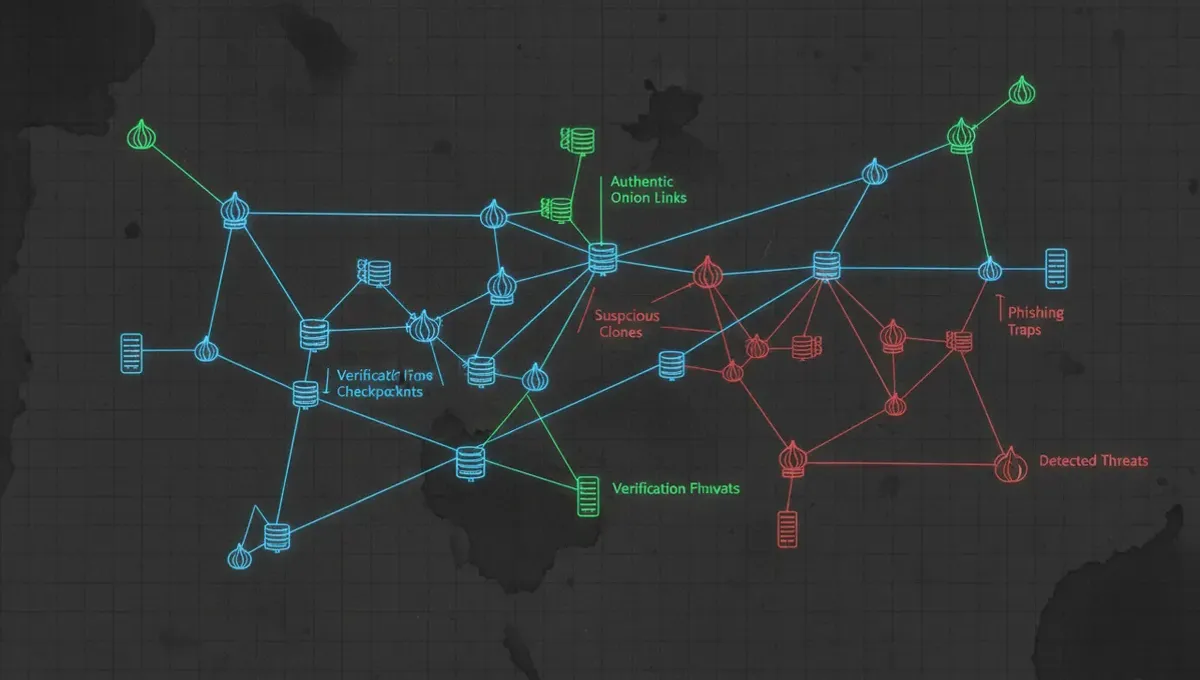
Phishing clones of popular dark web sites are common because attackers know users will search for the address each time they visit. To confirm you have the genuine onion link, follow these steps:
- Visit the official clearnet website (if one exists) and look for a link to the onion address or a PGP-signed announcement.
- Check the site's official social media accounts, GitHub repositories, or press releases for the correct .onion URL.
- Compare the address you found against multiple independent sources, including security blogs and the Useful Resources page of this site.
- Verify the PGP signature on any announcement using the organization's public key, which should be available on their clearnet site and in public key directories.
- Bookmark the correct address in Tor Browser and use only that bookmark to return to the site.
- Watch for subtle misspellings in the onion address, such as swapping the letter 'l' for the number '1'.
A best website for dark web access will have made its real address easy to verify through multiple channels. If you cannot find a PGP-signed confirmation or an official announcement, treat the address as unverified and do not log in or submit sensitive information.
Reality Check: How the Ecosystem Actually Works
According to Tor Project documentation, the onion network hosts thousands of services, but only a small fraction are actively maintained or legitimate. Security-vendor incident reports consistently show that users who land on phishing clones often do so because they searched for the address rather than bookmarking it the first time. Law-enforcement press releases about darknet market seizures reveal that even well-known sites can disappear overnight, leaving users unable to distinguish between a site that has been taken down and one that is simply offline for maintenance. Academic research on onion services shows that address spoofing and clone sites exploit the fact that onion addresses are long, random strings that are difficult to remember or verify by eye. This matters because it means the best darknet websites are those with strong verification mechanisms in place, not those with the most traffic or the most impressive claims. Trusting a site because you found it on Reddit or in a forum post is how users end up compromised.
News Archives and Censorship-Resistant Publishing
Among the best dark net websites are onion mirrors run by news organizations and archives. These services allow journalists to publish from countries with severe censorship and allow readers to access news without their ISP logging which stories they read. Major news outlets maintain official onion addresses, which are published on their clearnet homepages and updated regularly. Archives of leaked documents, historical records, and research papers also operate on onion services to ensure that information remains available even if a government or corporation attempts to remove it from the clearnet. The best website for dark web access in this category will have a clear mission statement, a publication history you can verify, and a method for readers to confirm the address. These services do not require you to create an account or download additional software beyond Tor Browser. They function as read-only repositories or news feeds, making them safe to visit as long as you are using an up-to-date Tor Browser and have not modified your security settings.
Privacy Tools, Documentation, and Communication Platforms
The best dark net sites for privacy-conscious users include onion addresses for encrypted messaging platforms, VPN providers, and privacy organizations. These services host documentation on how to use encryption, how to protect your operating system, and how to avoid deanonymization attacks. Some offer contact points for security researchers to report vulnerabilities without exposing their identity. Others provide mirrors of privacy guides and tools that may be blocked in certain countries. The best websites in dark web for this purpose are those run by established organizations with a history of transparency and regular security audits. They typically do not require you to create an account to read documentation, and any accounts they do offer use strong encryption by default. Verification is straightforward: check the organization's clearnet site, look for the onion address in their official documentation, and confirm the PGP signature on any announcements. These sites are designed to be stable and long-lived, so bookmarking the address after verifying it once is a safe approach.
Avoiding Scams and Staying Safe on Onion Sites
Even when you have verified that you are on a legitimate onion address, you should apply basic security practices. Never enable plugins or extensions in Tor Browser, as they can leak your IP address or compromise your anonymity. Do not maximize your browser window, as the dimensions can be used to fingerprint you. Assume that any site asking you to download a file or create an account poses a risk if you have not independently verified the site's legitimacy through multiple channels. If a site offers to sell you something, treat it as unverified regardless of its reputation. The best websites dark web will never pressure you to act quickly, will not ask for payment upfront, and will provide clear information about what they do and why. If you are visiting a forum or discussion board, remember that anyone can post there, including law enforcement and scammers. Read carefully, verify claims against other sources, and do not assume that because something is on the dark web it is trustworthy. The best site for dark web use is one where you can verify the operator's identity, understand the site's purpose, and see evidence that it has been online and maintained for a substantial period.
Your Next Step: Verify Before You Visit
The core takeaway is that the best deep web websites are those you can verify independently before you visit them. Rather than searching for an onion address each time, spend ten minutes now to confirm the real address through multiple sources, check the PGP signature if one is available, and bookmark it in Tor Browser. When you return to the site, use only your bookmark. If the site is offline or behaves unexpectedly, do not assume it has moved to a new address you found in a forum post. Instead, go back to the official clearnet source and confirm that the address has actually changed. Start by visiting the Useful Resources page of this site, which lists verified onion addresses for news archives, privacy organizations, and documentation projects. Pick one category that interests you, verify the address through the methods described above, and bookmark it. This single action will protect you from phishing clones and help you build a collection of trustworthy dark web resources.
Common Questions
How do I know if a dark web site is real or a phishing clone
Check the site's official clearnet website or social media for a PGP-signed announcement of the correct onion address. Verify the PGP signature using the organization's public key. Compare the address against multiple independent sources. Bookmark the verified address and use only that bookmark to return to the site. Never visit an address you found only in a forum post or Reddit thread without confirming it through an official channel first.
What are the best dark net websites for news and information
Major news organizations and archives maintain official onion mirrors, which are listed on their clearnet homepages. These include news outlets, document archives, and historical libraries. To find them, visit the news organization's main website and look for a link to their onion address. Verify the address through the methods described above before bookmarking it. These sites are designed to be read-only and do not require you to create an account.
Is it safe to create an account on dark web websites
Creating an account on any onion site carries risk because you are providing information that could be used to identify you. Only create an account on sites run by established organizations with a clear mission and a verifiable history. Use a unique username that is not connected to any of your other online identities. Never use the same password you use elsewhere. Be aware that even encrypted sites can be compromised or seized by law enforcement.
Can I trust sites that appear on dark web directories or forums
No. Directories and forums are maintained by users, not by the sites themselves, and they can contain outdated, incorrect, or malicious information. Always verify an onion address through the site's official clearnet source before visiting. If you cannot find an official source, treat the address as unverified and do not log in or submit sensitive information.
What should I do if a dark web site I trusted suddenly goes offline
Do not assume the site has moved to a new address. Instead, go back to the site's official clearnet website or social media and check for an announcement. If the site has been seized or shut down, the operator will typically post a message explaining what happened. If you cannot find any official announcement, wait a few days and check again. Never visit a new address you found in a forum post without confirming it through an official channel first.